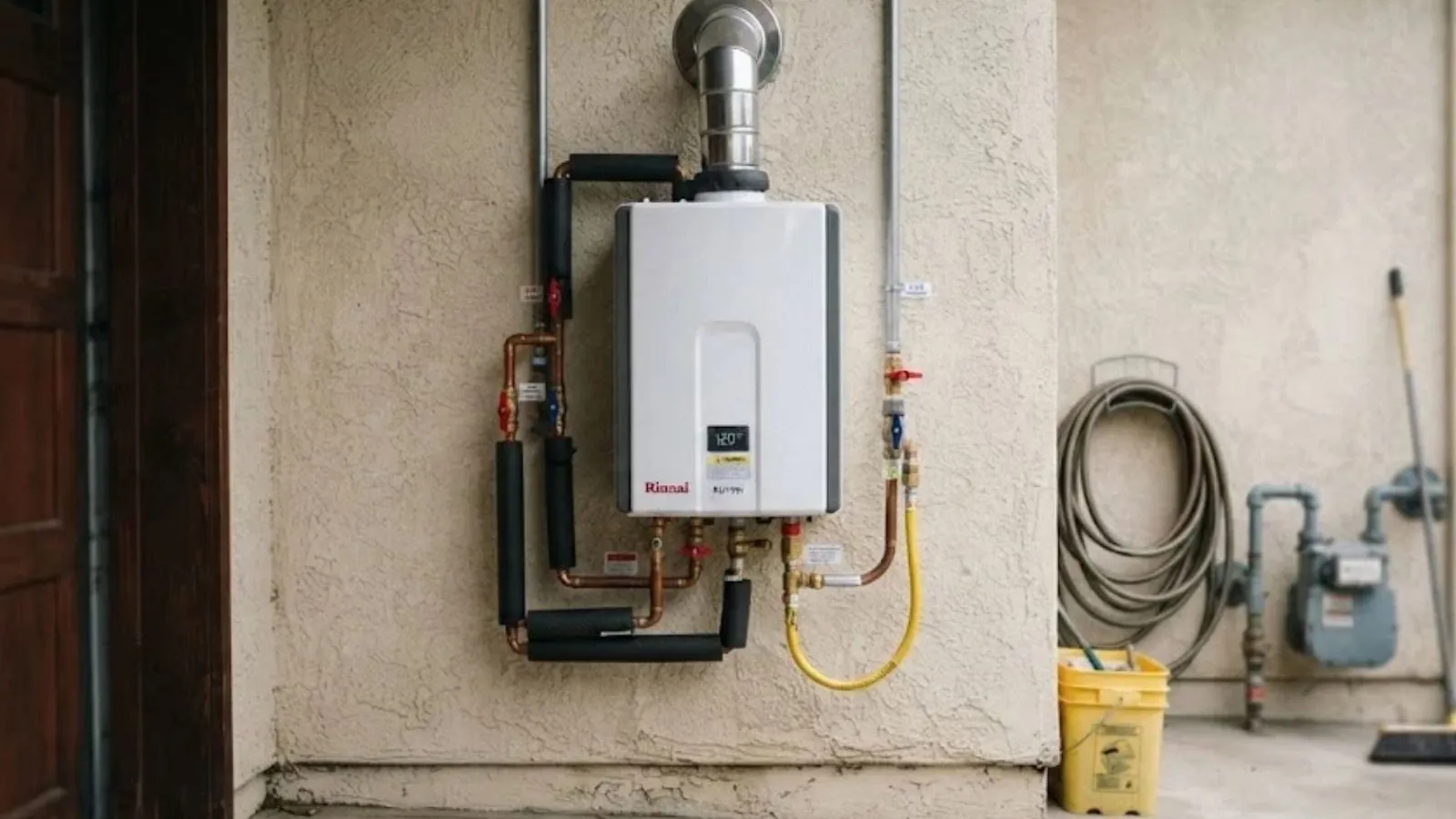
What an outdoor tankless heater is
An outdoor tankless heater is built to sit outside, usually mounted on an exterior wall. The cabinet is weather resistant, and it vents straight to the outdoors, so no flue runs through the house. Installers like them in warm climates, where they free a closet and avoid long vent runs.
In a cold climate the same design raises questions. Water inside the unit and in the pipes feeding it can freeze. Manufacturers add freeze protection, such as electric heaters inside the cabinet that run on cold nights. Those only work if the unit keeps its power, and a winter storm that cuts power is exactly when freezing is most likely.
Because of that, many plumbers in cold states prefer indoor units for most homes. An outdoor unit can still make sense in particular situations, and it helps to know how to judge them.
Outdoor versus indoor tankless in a cold climate
Here is how the two compare for a Minnesota house.
| Factor | Outdoor unit | Indoor unit |
|---|---|---|
| Freeze risk | Higher, depends on power for freeze protection | Low, in a heated space. |
| Venting | None needed through the house | Sealed vent through wall or roof. |
| Space | Frees indoor space | Takes wall space indoors. |
| Service access | Weather can limit service | Easier in any season. |
| Gas supply | Needs outdoor gas line routing | Gas line inside the house. |
| Best fit | Mild climates, heated enclosures | Most Minnesota homes. |
Questions to settle before you buy
These questions decide whether an outdoor unit is practical.
- What happens in a long power outage?Freeze protection stops working. Ask the installer how to drain the unit and lines.
- Where does the gas line run?Exterior gas piping adds cost and must be protected.
- How far is the unit from the fixtures?Long runs of cold pipe waste water and may freeze.
- Who will service it in winter?Snow and ice limit access.
- Is there a heated enclosure option?Some owners build one, which changes the cost.
Local note: permits and water
Plumbing and gas work in Inver Grove Heights goes through the city's Permits and Inspections office, which you can reach at 651-450-2550. Ask them what a water heater replacement or relocation needs before you commit to a layout.
The city also publishes hardness at 20 to 22 grains, so any tankless choice here, indoor or outdoor, should plan for descaling. A unit mounted outside is no easier to flush in January than one in a basement.
A practical alternative
If your goal is to free closet space or avoid a vent, an indoor tankless unit in a basement or garage utility space can do the same thing without freezing risk. If your goal is endless hot water, a larger tank or a heat pump model may meet the need with less complexity.
A plumber should size the unit for your peak demand, not for the number of bathrooms alone. A household that runs two showers and a dishwasher at the same time needs a higher flow rating than one where use is staggered. Our water heater installation page covers sizing in more detail.
If you already have an outdoor unit, protect it. Keep power on, check the freeze protection before winter, insulate exposed pipe and know how to shut off and drain it. Call us if you are not sure how.
Winter shutdown if you already have one
If you must leave a unit unpowered, such as in a vacant property, drain it. Close the isolation valves, open the drain ports and let the water out. Open the hot taps in the house to relieve pressure. Leave the valves partly open so any remaining water has room to expand.
In an emergency freeze, shut off the water and gas, switch off power at the breaker, and call. A frozen heat exchanger can crack, and a crack is a replacement, not a repair. See tankless water heater service.
Nearby towns such as Mendota Heights and Eagan see the same cold weather, and we cover both.
Questions to ask an installer about freeze protection
Ask how the freeze protection works and what it needs to run. Some systems use electric heating elements that draw power all winter. Others rely on a recirculation loop. Ask what temperature the system protects to and what happens during a power failure.
Ask whether the manufacturer's warranty covers freeze damage. Many warranties exclude it. Ask for a written drain-down procedure you can follow if a storm knocks out power. A good installer will walk through it and leave a copy with you.
Noise, snow and maintenance access
An outdoor unit sits where weather and snow can reach it. Keep the area around it clear of drifts so the intake and exhaust are not blocked. Check the cabinet for ice after storms, and keep a path to the unit for service.
Ask where the condensate goes. A condensing unit outdoors can drip onto a walkway and freeze into a sheet of ice. A neutralizer and a drain line that discharges safely away from foot traffic solve it.
Gas line routing and protection outdoors
An outdoor tankless unit needs a gas line that runs outside to the unit. That line needs protection from damage, proper support and the right sizing. In snow country, it also needs a regulator and a meter location that stay accessible in winter.
Ask the installer how the gas line is routed, whether it is sleeved or protected, and where the shutoff sits. A shutoff buried under a snowdrift is not much use in an emergency.
Questions to ask before you sign
Ask about the freeze protection method, the venting route, the gas line size and the service access. Ask who handles the permit and when the inspection happens.
Guidelines worth knowing
The installation manual is the standard to follow for clearances and venting, along with the Minnesota Plumbing Code (Minnesota Rules chapter 4714, based on the Uniform Plumbing Code, UPC).
Questions about outdoor tankless heaters in Minnesota
Yes. Freeze protection depends on power. A long outage in deep cold can freeze water in the unit and the pipes.
Plumbing and gas work generally goes through the city's permit process. Call Permits and Inspections at 651-450-2550 to confirm.
In most Minnesota homes, yes, because the space stays heated.
Yes. The city lists hardness at 20 to 22 grains, which scales any tankless heat exchanger.
Often. Gas line size, venting and electrical supply decide the cost.
Need help with this in Inver Grove Heights?
Call the 24/7 line and describe what is happening.
Call (651) 946-0134