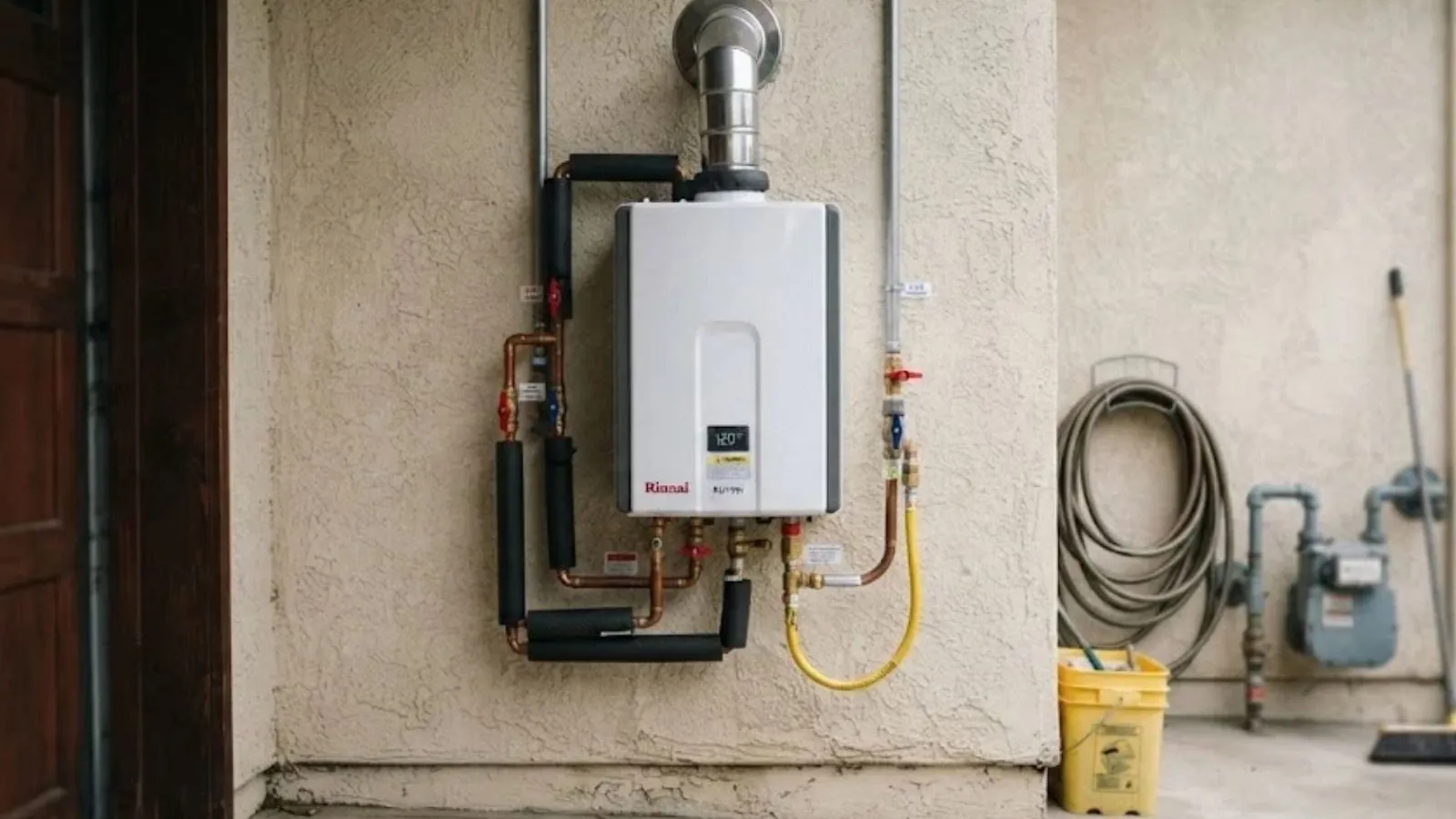
Tankless water heater service in Inver Grove Heights, MN
A tankless water heater heats water as it flows, with no storage tank to run empty. Tankless water heater service in Inver Grove Heights covers installation, repair, flushing and descaling for gas and electric units. The work is scheduled, and we offer same-day appointments when available.
Tankless units trade a big tank for a compact heat exchanger. That heat exchanger is also where the trouble starts. It has narrow passages, and the water that runs through them in Inver Grove Heights is very hard. The city lists hardness at 20 to 22 grains per gallon.
That hardness is why tankless owners in this area ask us about flushing sooner than owners in a soft-water town do.
Flushing and descaling: the service that matters most
Descaling is a recirculating flush that dissolves scale from the heat exchanger with a mild acid solution, usually white vinegar or a manufacturer-approved descaler. It takes a pump, two hoses and the unit's service valves. Without service valves, a tankless unit cannot be flushed properly, and adding them is the first thing we do.
Signs that a unit needs descaling include a fluctuating temperature, a slow warm-up, a drop in flow, and error codes tied to temperature or flow. In hard water, many manufacturers recommend yearly service. If you have never flushed yours, schedule it now rather than waiting for the fault code.
After the flush we clean the inlet screen, check the combustion and vent on gas models, and test output temperature at the farthest fixture.
Common tankless problems
These are the faults we see most often.
| Problem | Likely cause | Fix |
|---|---|---|
| Water runs cold, then hot | Scale on the heat exchanger or a low-flow shutdown | Descale, clean the inlet screen. |
| Error code on display | Flow, ignition, venting or temperature fault | Read the code, test the sensor or igniter. |
| Low hot water flow | Clogged inlet screen or a scaled exchanger | Clean, then flush. |
| Cold-water sandwich | A normal short gap between hot water bursts | Adjust fixture use, recirculation option. |
| No hot water at all | Power, gas, vent or ignition failure | Diagnose, repair or replace. |
Is tankless right for your house?
A tankless unit is a good fit in some homes and a poor one in others.
- Gas line capacityTankless gas units draw a large burst of fuel. Older homes may need a bigger gas line.
- VentingMost tankless units use a sealed vent. Existing flues from old tanks rarely work.
- Water hardnessIn hard water, plan on yearly descaling or a softener ahead of the unit.
- Peak demandIf two showers and the dishwasher run together, the unit must be sized for it.
- SpaceWall-mounted units free floor space, which suits tight utility rooms.
Compare options on our water heater installation page if you are still choosing.
What drives tankless service and installation cost
We give a clear price before work starts.
Call for your real number: (651) 946-0134.
Gas supply and venting: what a tankless install needs
A gas tankless heater fires a large burner for short bursts, so it needs more gas flow than a storage tank of the same household size. An older gas line sized for a small tank may need to be upgraded. We measure the run and the total load of the appliances on the line before we quote.
Venting is the other big item. Most tankless units use a sealed, stainless or plastic vent that runs through a wall or roof, and the old flue from a tank heater is usually not suitable. High-efficiency units also produce acidic condensate that needs a drain or a neutralizer.
Electric tankless units need a heavy electrical supply, often more than a panel has to spare. Check the capacity of your panel before you commit to one.
Code and permits
Tankless installs touch gas sizing, venting and drain requirements, all of which are covered by the Minnesota Plumbing Code (Minnesota Rules chapter 4714, based on the Uniform Plumbing Code, UPC) and by the manufacturer's instructions. Follow the manufacturer's installation manual and ask your installer how the permit and inspection will be handled.
Tankless water heater questions
Manufacturers commonly recommend yearly service, and in hard water that is a minimum. Inver Grove Heights water is listed by the city at 20 to 22 grains per gallon.
Often, yes. Many codes point to a clogged inlet screen, a scaled exchanger, a dirty igniter or a vent restriction. We read the code and test the part.
Yes. It reduces the scale that builds on the heat exchanger. See our softener page.
Yes. For a leaking unit, close the shutoff valves and the gas, then call the 24/7 line. See also our water heater repair page.
With regular descaling, many last well beyond a standard tank. Neglect in hard water shortens that a lot.
Yes. Start with Mendota Heights or West St. Paul for what those pages cover.
Tankless unit throwing errors?
Call the 24/7 line. Give us the model and the code on the display.
Call (651) 946-0134