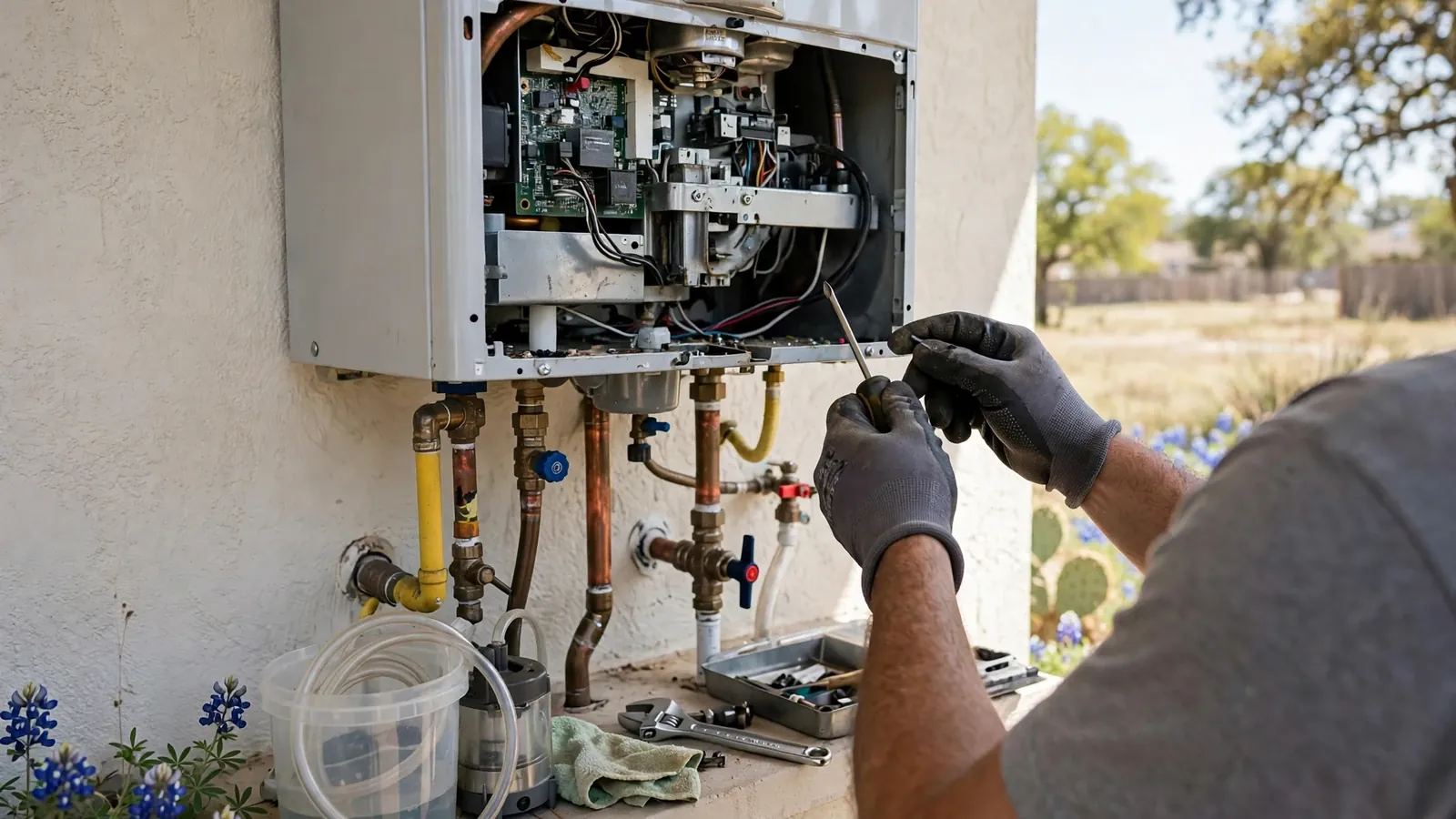
What an instant water heater does and why it fails
A tankless heater has no storage tank. When you open a hot tap, a flow sensor sees water moving and fires a burner or energizes heating elements. Water passes through a heat exchanger and leaves hot. The design saves space and avoids standby heat loss, but it concentrates all the work in a small part.
That heat exchanger has narrow passages. Minerals in the water settle in those passages as scale, and scale insulates the metal, so the unit has to work harder to heat the same flow. Eventually it overheats, trips a safety and shows an error code. Most instant water heater repairs come down to scale, a dirty filter screen, a failed sensor or a venting problem.
If your unit is a gas model, always treat a gas smell as an emergency. Leave the house, call your gas utility or 911, and do not use switches or phones inside.
Symptoms and what to check first
Start with the simple checks before calling anyone.
| Symptom | Check first | Likely repair |
|---|---|---|
| No hot water at all | Power, gas valve, breaker, error code | Igniter, sensor, board or vent fault. |
| Water runs cold, then hot | Flow rate, inlet screen | Clean the screen, descale the exchanger. |
| Temperature swings | Other taps running at the same time | Descale, check the flow sensor. |
| Error code on the display | Look the code up in the manual | Depends on the code. |
| Low hot water flow | Aerators and the inlet filter | Clean screens, flush the unit. |
| Leak at the unit | Shutoff valves and fittings | Tighten or replace fittings, call if the exchanger leaks. |
A safe flush you can ask a plumber to do
Descaling is the most common service on a tankless heater. It uses a pump and a mild acid solution, often white vinegar, circulated through the unit.
- Shut off power and gasThe unit must be off before any hose is connected.
- Close the water valvesUse the isolation valves on the hot and cold lines.
- Connect the hosesA pump sends the solution through the heat exchanger and back to a bucket.
- CirculateLet it run for a set time, usually about an hour, until the solution runs clear.
- Rinse and restoreFlush with clean water, clean the inlet screen, reopen the valves and test.
If your unit has no isolation valves, adding them is the first job. Without them, a proper flush cannot be done. Our tankless water heater service page explains what is included.
Local note: Inver Grove Heights hardness
The City of Inver Grove Heights publishes its water hardness as 370 mg/L as calcium carbonate, or 20 to 22 grains. Its 2024 drinking water report says the water comes from six wells in the Jordan aquifer. Water at that hardness is the reason tankless heaters in this area need flushing on a schedule instead of only after a fault.
In practical terms, if you have not had your unit flushed in a year, plan a visit before cold weather. A flush is far cheaper than a heat exchanger. If you are shopping for a unit, ask about a softener ahead of it.
When to repair and when to replace
A tankless unit with a clogged screen or a scaled exchanger is a repair. A unit with a cracked heat exchanger or a failed main board on an older model may be better replaced, depending on cost. Many manufacturers rate units for fifteen years or more with regular care, but neglect in hard water shortens that.
Ask for the model and serial number, the error code, and a photo of the data label. A plumber can often tell you by phone whether parts are available and whether the repair is worth it. If the unit is leaking from the exchanger, shut off the water and gas and call.
For tank-style heaters, our water heater repair page covers the same kinds of problems on a different design.
Gas, venting and condensate
Gas tankless units rely on a sealed vent. A blocked vent, a bird nest, or ice on a vent terminal in winter can shut the unit down. High-efficiency condensing models also produce acidic condensate that must drain away. A clogged condensate line shows up as an error code or a puddle.
These checks are for a plumber, not for a homeowner. A vent that is not clear can leak carbon monoxide into the house. Make sure your carbon monoxide alarms work, and replace the batteries on schedule.
If your heater is in Eagan or Rosemount, we cover both on the same dispatch. See Eagan and Rosemount.
Buying a replacement part or a replacement unit
Before you buy a part online, confirm the model and serial number. Tankless parts are model specific, and a similar looking igniter or sensor may not fit. If the unit is out of production, parts may be hard to find, and a repair that depends on a rare board is a poor bet.
Consider what else is wrong. A unit that needs a new board and also has a scaled heat exchanger is often better replaced. Ask for a written comparison of the repair and the replacement, including the venting and gas line work that a new unit might need.
Keeping records helps every repair
Keep the manual, the install date and a note of each service visit near the unit. When a fault returns, the history shows whether a flush, a part swap or a vent fix helped last time.
Guidelines worth knowing
Follow the manufacturer's guidelines for descaling and venting, and know that gas and venting work falls under the Minnesota Plumbing Code (Minnesota Rules chapter 4714, based on the Uniform Plumbing Code, UPC).
Questions about instant water heater repair
At least once a year. The city lists hardness at 20 to 22 grains, which is very hard, so scale builds quickly.
Codes point to flow, ignition, venting or temperature faults. The manual lists them. Many clear after cleaning the inlet screen or flushing.
Cleaning an inlet screen is a safe homeowner task if you turn off water and power first. Gas and vent work is for a plumber.
It depends on access and the condition of the unit. We give a clear price before work starts.
It is strongly worth considering. A softener reduces scale and the number of flushes your unit needs.
Need help with this in Inver Grove Heights?
Call the 24/7 line and describe what is happening.
Call (651) 946-0134