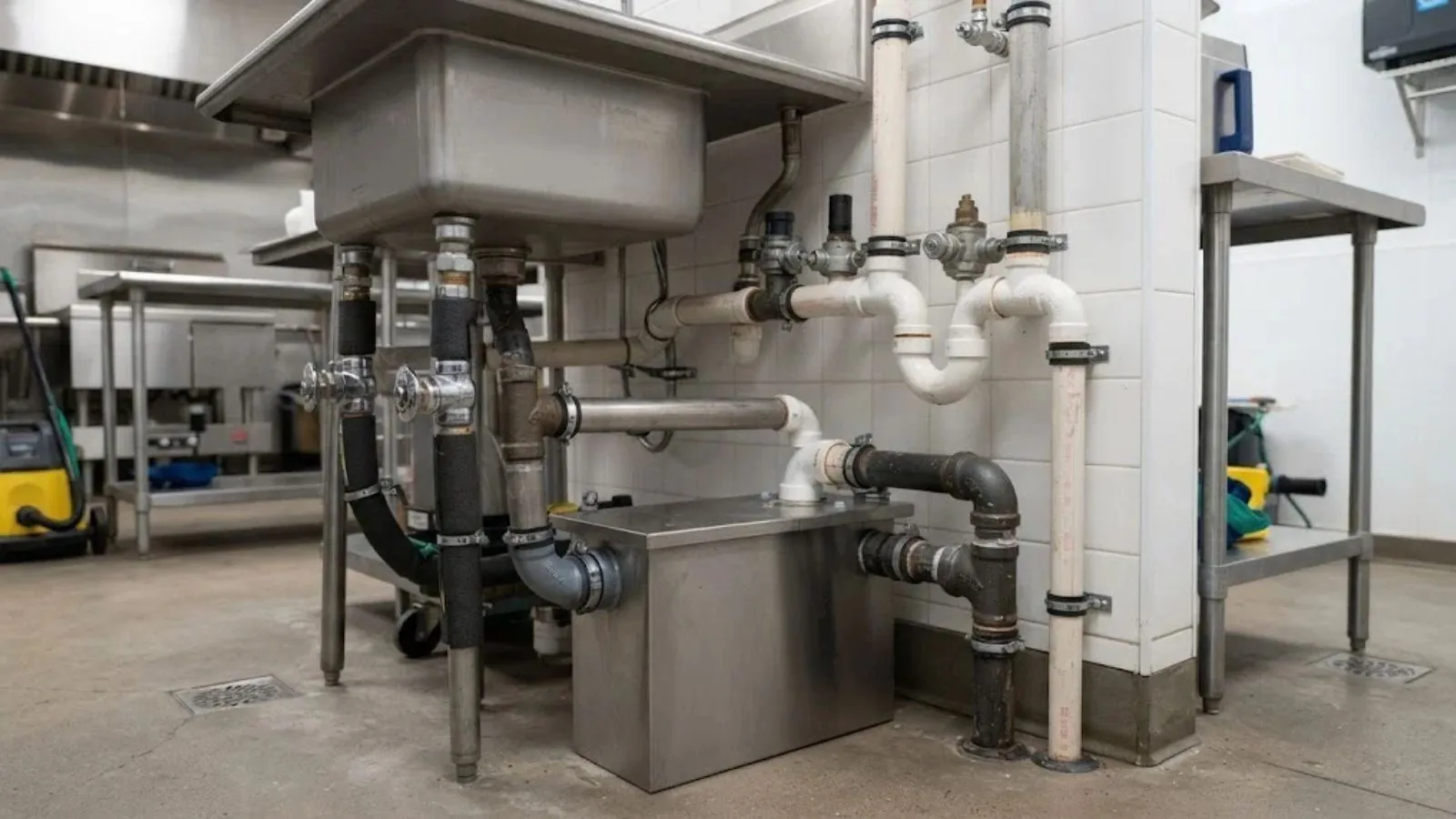
Commercial plumbing in Inver Grove Heights, MN
Commercial plumbing in Inver Grove Heights covers the pipes in shops, restaurants, offices, light industrial buildings and multifamily properties. Emergency commercial plumbing is available 24/7, because a backed-up restroom or a kitchen drain that will not clear can close a business for the day.
Commercial systems differ from a house. Pipes are larger, fixtures are used by many people, and a single failure can affect several tenants. A water heater may serve a whole building, and a floor drain may connect to a grease interceptor.
We ask three things on the first call: what kind of building, what is failing, and whether there is a shutoff nearby. With those, we know what to bring.
When a business plumbing failure is an emergency
Close the business area first if sewage or large amounts of water are on the floor. That is a safety issue for staff and customers, and in a food business it can also be a health department issue. Photograph the damage, then call.
Stop using the affected fixtures. If water is spraying or pooling, find the nearest shutoff valve. The building main is usually near the water meter, and your landlord or property manager may know where. Cut power to wet equipment only if you can do so safely.
In a leased space, tell your landlord right away. Responsibility for pipes inside the walls and pipes serving your unit alone can differ, and the lease decides who pays.
Common commercial plumbing calls
These are the problems we see most.
| Business type | Typical problem | Usual fix |
|---|---|---|
| Restaurant or cafe | Kitchen line grease buildup, slow floor drain | Jetting, scheduled grease-line cleaning. |
| Office or retail | Restroom clogs, running toilets, small leaks | Fixture repair and branch line clearing. |
| Multifamily | Shared stack backups affecting several units | Main line cleaning and camera check. |
| Salon or clinic | Sink traps loaded with hair or debris | Trap service, line clearing. |
| Any building | Water heater failure | Repair or replacement, often with a short outage. |
Questions that speed up a commercial call
Answer these when you call and the visit goes faster.
- Who is the contact on site?We need someone who can authorize work and give access.
- Is there a grease interceptor?It changes how we clear kitchen lines.
- Which fixtures are affected?One restroom or the whole building.
- Who owns the pipe?Tenant, landlord or both. It determines who approves the work.
- Can the business stay open?We plan around your hours when we can.
Related services are on our drain cleaning and sewer line cleaning pages.
Hard water and commercial equipment
The City of Inver Grove Heights reports hardness of 20 to 22 grains, and the source is groundwater from deep municipal wells. For a business, scale is a cost: it shortens the life of water heaters, coffee and ice equipment, dishwashers and steam equipment, and it clogs fixtures faster than soft water would.
A softener on the line feeding hot-water equipment is common in food service for that reason. See water softener and filtration for what it does and what it needs.
Flushing water heaters and checking relief valves on a schedule is cheaper than an emergency replacement in the middle of a lunch rush. If you run a restaurant, ask about a scheduled grease-line cleaning.
What decides commercial plumbing cost
We give a clear price before work starts.
Call for your real number: (651) 946-0134.
Preventive maintenance for business plumbing
A scheduled visit costs less than a shutdown. For a restaurant, that means regular grease line cleaning and a check of floor drains. For an office or shop, it means testing shutoff valves, flushing water heaters and checking restroom fixtures for slow leaks.
Keep a simple map of your building: where the main water shutoff is, where the cleanouts are and which fixtures share a drain line. Staff who know where to find the shutoff can limit damage in the first minutes of a leak.
If you manage several tenants, agree in advance who calls the plumber and who pays for what. A clear plan avoids delays when water is on the floor.
Code and permits
Commercial plumbing work follows the Minnesota Plumbing Code, Minnesota Rules chapter 4714, which is based on the Uniform Plumbing Code (UPC), along with any extra rules from the city, the fire marshal or your insurer. Share any lease terms or inspection notices with us when you call, so the work is scoped to what your building must meet.
What to do before we arrive
- Close the main water valve if water is flowing, and tell staff where it is.
- Keep customers and employees away from wet floors, and put out warning signs.
- Do not touch electrical equipment near water.
- Note which fixtures are affected, and take photos for your insurer.
Commercial plumbing questions
Yes. We dispatch around the clock for backups, burst pipes and failed water heaters in commercial buildings.
Yes. Kitchen lines are among our most common commercial calls. Hydro jetting handles grease buildup better than a cable.
The lease decides. We document the problem so you and your landlord can sort it out.
Yes. We schedule around your hours when the problem allows.
Yes. See Eagan and Mendota Heights.
Many do. Contact the city's Permits and Inspections office at 651-450-2550 to confirm for your project, and we handle the paperwork.
Plumbing problem at your business?
Call the 24/7 line. Tell us the address and the problem.
Call (651) 946-0134