Confirm that you have a leak
Turn off every fixture and appliance that uses water. That includes the dishwasher, washing machine, ice maker and any irrigation. Check that no one is running a tap or flushing a toilet. Then go to the meter, usually in the basement or utility room near where the water line enters the house.
Look for a small dial, triangle or wheel that spins when water flows. This is the low-flow indicator. If it moves with everything off, water is leaving the system. If your meter has a digital display, write down the reading, wait twenty minutes with no water use and read it again. A change is a leak.
Do not rely on the bill alone. A bill can rise from a change in use, a season or a rate change. A meter test is direct.
Narrowing down the location
Work from the easiest and cheapest suspect to the hardest.
- Test the toiletsAdd a few drops of food coloring to each tank. If color shows in the bowl within fifteen minutes without flushing, the flapper leaks.
- Check the visible pipesLook under sinks, behind the washer and around the water heater for drips and stains.
- Check outdoor faucetsA hose bib or an irrigation valve can leak inside a wall or underground.
- Shut the main and watch the meterClose the house main valve. If the meter still moves, the leak is between the meter and the valve or in the service line.
- Read it again with the main openIf it stops when the main is closed, the leak is inside the house.
That last two-step test splits the problem into inside and outside, which is the question that matters most for cost.
What each result means
Use the table to read your test.
| Result | Likely location | Next step |
|---|---|---|
| Meter moves, stops when main is closed | Inside the house | Test toilets, then call for leak detection. |
| Meter moves even with main closed | Between the meter and the main valve, or the meter itself | Call the city and a plumber. |
| Wet patch in the yard, meter moves | Service line | Call a plumber for service line repair. |
| Warm spot on a floor | Hot water line under a slab | Call for leak detection. |
| Meter still, bill high | Seasonal use or a past leak | Compare with prior bills. |
Local note: who handles what in Inver Grove Heights
The City of Inver Grove Heights handles the city water main and the meter. For water main breaks or emergencies it lists Utility Maintenance at 651-450-4309 from 7 a.m. to 3:30 p.m., and Dakota County Dispatch at 651-322-2323 after hours. The city also lists a separate billing line for questions about your bill.
The pipe from the meter to your house is generally yours. Water that hardens to 20 to 22 grains, as the city reports, scales and corrodes older steel and copper lines. That makes pinhole leaks more likely in older plumbing.
When the leak is outside
Signs of a service line leak include a soggy patch in the yard with no rain and a sudden pressure drop. Others are the sound of water at the meter with everything off, and a meter that runs when the main valve is closed. A line that freezes and splits in winter shows up when the ground thaws.
Shut the main valve to stop the loss, then call. We find the leak with acoustic and thermal tools, and we explain whether the repair is a spot dig or a full replacement. See leak detection and water service line repair.
The City of Inver Grove Heights has completed its service line materials inventory. Owners can check their line's material through the state's Lead Inventory Tracking Tool.
What a plumber can do that you cannot
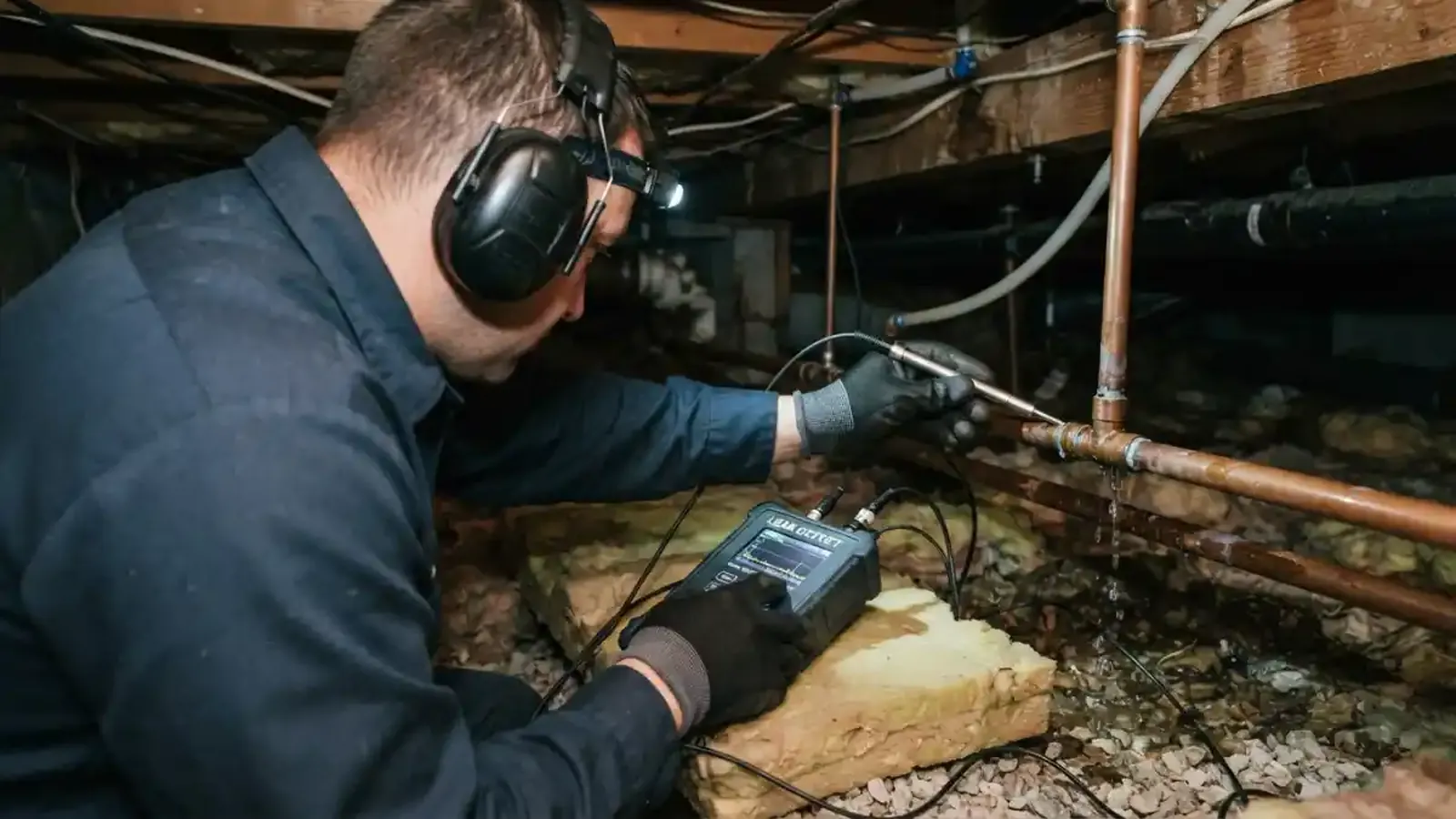
Acoustic listening picks up the sound of water escaping from a pressurized pipe, even under concrete. Thermal imaging shows warm spots from hot-water leaks. A moisture meter maps dampness behind drywall. A pressure test isolates zones of piping.
These tools save you from opening walls to look. A leak you can find without demolition costs far less to fix. If your home is in Mendota Heights, where St. Paul Regional Water Services supplies water, a main issue goes to that utility. In Rosemount, Public Works is at 651-322-2022 for city water questions.
Keep your meter test notes. They help the plumber and your insurer.
Common sources of hidden water loss
Toilets are the leading cause, because a flapper that does not seal lets water trickle into the bowl all day without a sound. Irrigation systems and outdoor faucets come next, especially a hose bib that drips inside the wall. Water softeners with a stuck valve can run to the drain for days.
Water heaters can leak slowly from a relief valve or a fitting. A dishwasher or ice maker supply line can drip behind an appliance. Check these places before assuming a buried leak, since a fixture repair costs far less than excavation.
What to do while you wait for a plumber
If the meter confirms a leak and you cannot find it, close the main valve when you leave the house or go to sleep. This stops the loss and the damage. Open the valve when you need water, and note how often the meter moves.
Take photos of the meter reading and the date. If your water bill is high, those notes help when you talk to the city's utility billing office about an adjustment.
Check the simple suspects first
Toilets are the most common hidden leak. Add a few drops of food coloring to the tank and wait fifteen minutes without flushing. If color shows in the bowl, the flapper is leaking and needs replacing.
Guidelines worth knowing
According to the City of Inver Grove Heights, Utility Maintenance at 651-450-4309 can help rule out a city-side water issue, and the Minnesota Plumbing Code (Minnesota Rules chapter 4714, based on the Uniform Plumbing Code, UPC) governs any pipe repair that follows.
Questions about a running water meter
A steady drip adds up to thousands of gallons over a year. A running toilet can use much more.
Sudden damage may be covered. Gradual leaks often are not. Check your policy.
Often yes. Replacing a flapper is a simple DIY job.
In Inver Grove Heights, call Utility Maintenance at 651-450-4309 by day or Dakota County Dispatch at 651-322-2323 after hours.
Yes, if the leak is active and you can reach the main valve.
Need help with this in Inver Grove Heights?
Call the 24/7 line and describe what is happening.
Call (651) 946-0134