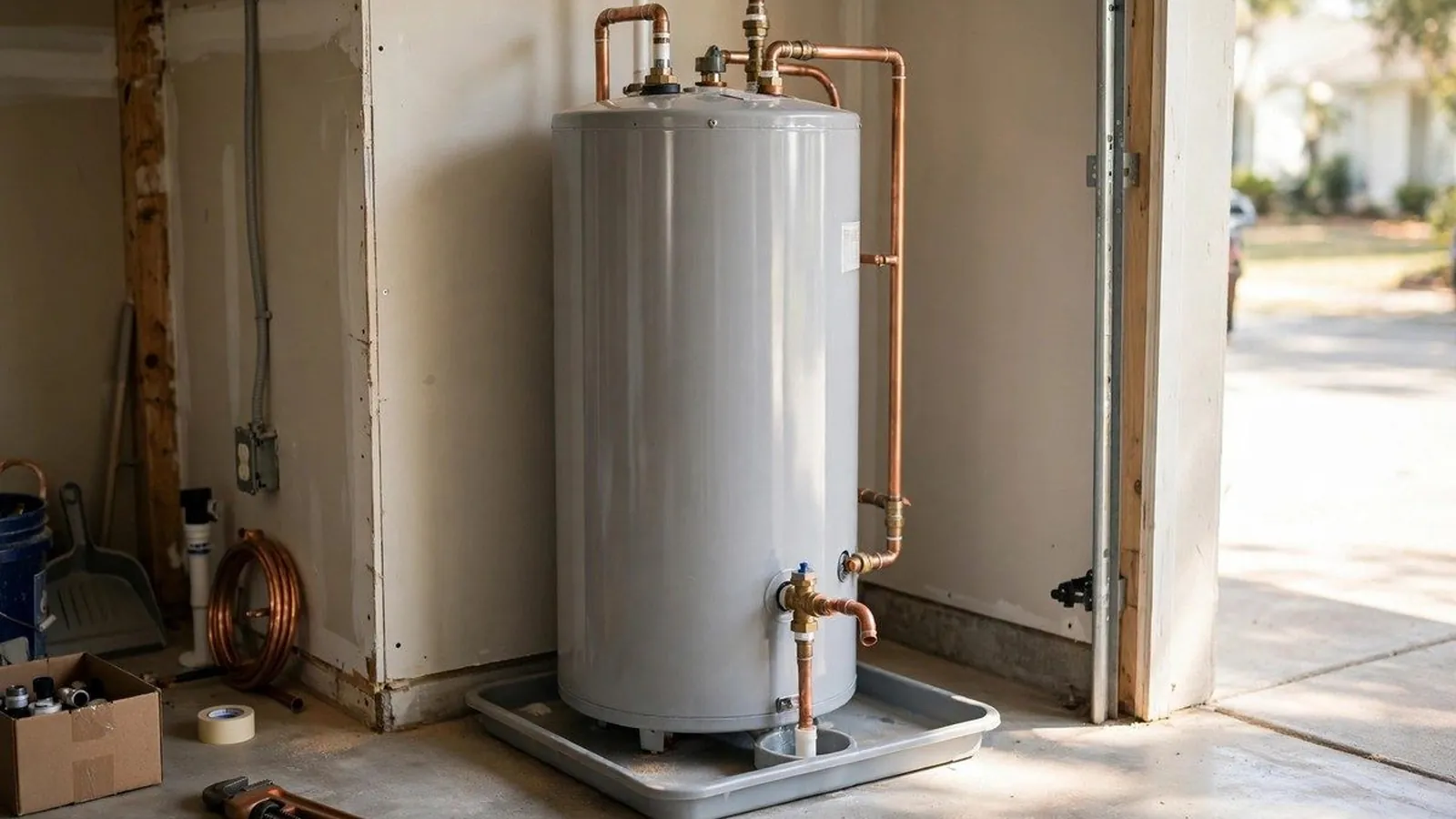
How a heat pump water heater works
A heat pump water heater looks like a tank with a compact unit on top. The unit pulls warm air across a coil, extracts the heat and transfers it to the water. As a side effect it cools and dries the air around it, which is a bonus in a damp basement and a drawback in a small closet that needs heat.
Most models also include electric elements as a backup, and offer modes that balance efficiency against recovery speed. In the most efficient mode, recovery is slower than a standard electric tank. In a hybrid or electric mode, it behaves more like one.
Because they exchange air with the room, they need space and airflow. A tight closet with no ventilation can starve the unit and cut efficiency.
What the installation needs
Check these items before you choose a model.
| Requirement | Why it matters | Typical solution |
|---|---|---|
| Air volume | The unit needs room to draw air from | Install in a basement or large open room. |
| Clearance | Airflow and service access | Follow the manufacturer's spacing. |
| Condensate drain | The coil produces water | Gravity drain or a small pump. |
| Electrical | Dedicated circuit, often 240 volt | Electrician adds or confirms the circuit. |
| Room temperature | Efficiency drops in cold rooms | Avoid unheated spaces. |
| Noise | A fan and compressor run | Avoid placing near bedrooms. |
How the install goes
A heat pump water heater installation follows a familiar order.
- Site checkWe confirm space, airflow, floor drain, electrical and the route for supply lines.
- PermitThe work goes through the city permit and inspection process.
- Drain and remove the old tankThe old heater is drained and removed.
- Set and connectThe new unit is placed on a pan or near a drain, supply lines and a relief valve are connected.
- Electrical and condensatePower is connected and the condensate drain is routed.
- Fill, test, inspectWe fill the tank, purge air, set the mode and arrange the final inspection.
Local note: permits and hard water in Inver Grove Heights
Plumbing and electrical work in Inver Grove Heights goes through the city's permit and inspection process. The Permits and Inspections office is at 651-450-2550. Ask what your project needs before the install date.
The city publishes water hardness of 20 to 22 grains and says its water comes from six wells in the Jordan aquifer. The heating coil of a heat pump unit is outside the tank, but the tank itself still collects sediment. Plan a yearly flush and an anode rod check, and consider a softener.
Is it worth it for your house
A heat pump unit costs more up front than a standard tank, and the savings depend on what you pay for electricity or gas now. If you are replacing an electric tank, the savings can be substantial. If you are replacing a gas tank, the comparison is less clear and depends on fuel prices.
It makes the most sense in a house with a basement that is large enough, warm enough and has a floor drain. It makes the least sense in a closet on a cold north wall. Our water heater installation page covers options for different homes.
If your current heater has failed and you need hot water now, a standard tank is the faster fix. See water heater replacement. You can plan a heat pump upgrade for a later swap.
Where we install
We install water heaters in Inver Grove Heights and the nearby towns. Older homes in West St. Paul often have smaller utility spaces that need extra planning. Newer homes in Rosemount often have basements well suited to heat pump units.
Whatever the town, we begin with the site check. A heat pump unit placed in the wrong room is a disappointment. In the right room, it is a quiet, efficient machine.
Ask us about the condensate drain early. If the floor drain is far away, a small pump is a simple fix, but it needs power and an eventual replacement.
Settings and what to expect after installation
Most heat pump water heaters offer several modes. An efficiency mode uses the heat pump only. A hybrid mode adds electric elements when demand is high. A high-demand mode relies more on the elements. Start in hybrid, and move to efficiency if hot water keeps up.
Expect the basement to feel a little cooler and drier near the unit, because the machine pulls heat and moisture from the air. Clean the air filter on the schedule the manual gives, and keep the condensate line clear. A clogged condensate line can shut the unit down.
Electrical capacity and the panel
A heat pump water heater needs a dedicated circuit, usually 240 volts. Many homes already have one for the old electric tank. A home with a gas tank may not, and adding a circuit requires panel capacity and an electrician. Ask for a load calculation if your panel is full.
If the panel has no room, other options exist, such as a smaller unit or a panel upgrade, and the cost of that work belongs in your comparison. A heat pump water heater that saves energy but needs a large electrical project may not pay back.
Space, airflow and noise
A heat pump unit pulls heat from the air around it, so it needs room to breathe. Ask the installer about clearance, about the size of the room and about a condensate drain, because the unit makes water as it works. A tight closet is a poor home for one.
The unit also hums, and it cools the space it sits in. A basement corner is often a good fit, while a bedroom wall is not. Plan the location before you pick the model.
Questions about heat pump water heaters
Yes, if the basement is large enough and stays above the unit's minimum temperature. Unheated spaces reduce efficiency.
Plumbing and electrical work generally goes through the city. Call Permits and Inspections at 651-450-2550 to confirm.
A fan and compressor run, at a level similar to a dehumidifier. Avoid placing it next to a bedroom.
Scale still builds in the tank. The city lists hardness at 20 to 22 grains, so flush it yearly.
Often, but the savings depend on fuel prices and electrical capacity.
Need help with this in Inver Grove Heights?
Call the 24/7 line and describe what is happening.
Call (651) 946-0134