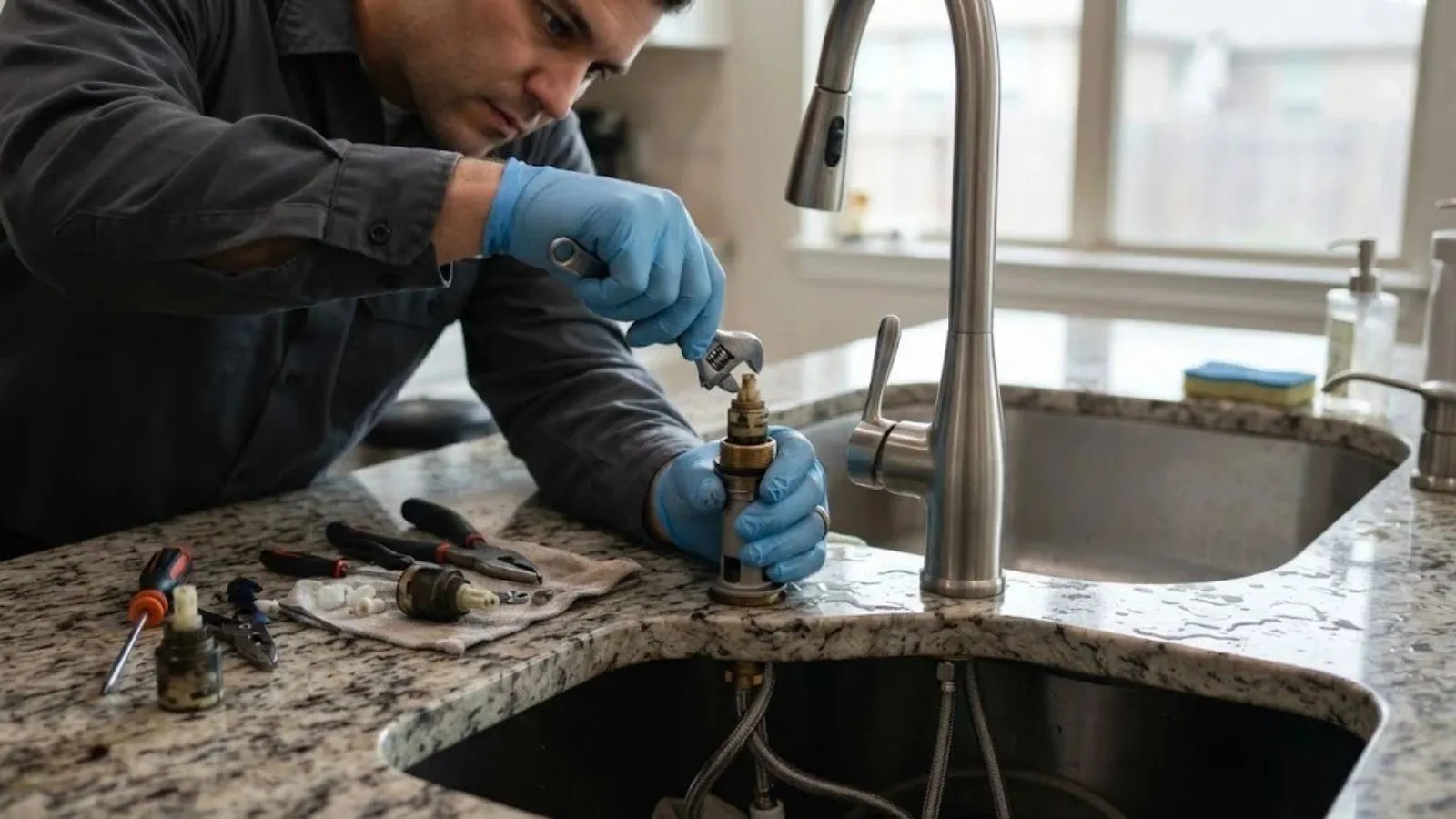
Know your model first
Grohe bathroom faucets come in single-handle and two-handle styles, with cartridges, aerators and mounting hardware that vary by series. Before you order a part, identify the model. Look for a model number on the underside of the faucet body or on the original box and manual. If you cannot find one, a photo of the faucet from the front and the side helps a parts supplier.
Most single-handle models use a ceramic cartridge that controls flow and temperature. Two-handle models may use a separate cartridge for each side. The cartridge is the part that fails most often in hard water.
Shut off the water at the small valves under the sink before you start. If a valve will not turn or leaks, stop and call a plumber. Forcing it can break the stem.
Common problems and likely causes
Start with the symptom.
| Problem | Likely cause | Typical fix |
|---|---|---|
| Drip from the spout | Worn or scaled cartridge | Replace the cartridge. |
| Low flow or spray | Clogged aerator or inlet screens | Soak the aerator in vinegar, clean the screens. |
| Handle is stiff | Mineral buildup in the cartridge | Clean or replace the cartridge. |
| Handle is loose or wobbles | Loose set screw or worn handle adapter | Tighten or replace. |
| Leak at the base | Worn seals or loose mounting nut | Replace seals, tighten the mount. |
| Water under the sink | Supply hose or shutoff valve leak | Replace the hose or valve. |
Replacing a cartridge
This is a general sequence. Follow your model's instructions.
- Shut off the waterClose both shutoff valves and open the faucet to release pressure.
- Remove the handlePry off the cap, loosen the set screw and lift the handle.
- Remove the retaining ring or capUnscrew it to expose the cartridge.
- Pull the old cartridgeNote its orientation before removing.
- Install the new cartridgeSeat it in the same orientation and tighten the retaining part.
- Reassemble and testOpen the valves slowly and check for leaks.
Use a plug or a towel in the drain so small parts cannot fall in.
Local note: hard water and faucet life in Inver Grove Heights
The City of Inver Grove Heights publishes its hardness as 370 mg/L as calcium carbonate, or 20 to 22 grains. That is very hard water, and it is the leading reason cartridges stiffen and aerators clog in this area. A faucet that lasted ten years in a soft-water town may need a cartridge much sooner here.
Soaking the aerator in white vinegar every few months, wiping the spout and handle after use, and considering a softener all extend faucet life. If your whole house shows white crust on fixtures, see our water softener and filtration page.
When to repair and when to replace
If the cartridge is the only failed part and the finish is sound, repair. If the finish is pitted, the body is corroded or you have replaced parts more than once, replace the faucet. If the model is old and parts are scarce, replacing costs little more than chasing parts.
A new faucet is a good time to replace the shutoff valves and supply hoses under the sink. They age along with the faucet, and a failure there floods the cabinet. Our faucet and sink repair and plumbing installation pages describe what we do.
If your faucet is in a home in Eagan or Mendota Heights, we cover both.
Tools and safety
You will need an adjustable wrench, a screwdriver set, a hex key for set screws, plumber's grease and a bucket. Work with a towel under the sink to catch drips. Wear safety glasses when removing old parts that may release grit.
Never use pliers directly on a chrome finish. Wrap the jaws in tape. Use plumber's grease on seals, not general lubricants that can damage rubber.
If anything feels wrong, stop. A stripped screw or a cracked body is a replacement, and a plumber can finish the job.
Buying the right part
Cartridges look alike but are not interchangeable. Take the old cartridge to a plumbing supply counter, or match the part number stamped on it. A cartridge that is a few millimeters off will leak or bind. Buy genuine parts or well-reviewed matches, and keep the receipt.
While the faucet is open, replace the O-rings and wipe the seat clean. Apply a thin film of plumber's grease. A repair that includes these small parts lasts longer than a bare cartridge swap.
Cleaning and caring for the finish
Hard water spots and soap film dull a faucet's finish. Wipe the faucet dry after use and clean it with a soft cloth and a mild cleaner. Avoid abrasive pads and harsh chemicals, which strip the plating. A diluted vinegar wipe removes light scale, but rinse it off, and do not use it on natural stone nearby.
Low flow after a repair
If flow is weak right after you replace a cartridge, check for debris. Loosened scale can lodge in the aerator or the inlet screens. Remove the aerator and run the water for a few seconds to flush the line, then clean the aerator and put it back.
Also check that the shutoff valves under the sink are fully open and that the supply hoses are not kinked. A partly closed valve is a common reason for weak flow after any faucet work.
Know when to stop and call
Stop when a part will not budge, when the faucet body is cracked, or when water appears at a place you did not touch. Forcing a seized fitting can crack the valve or the sink and turn a small repair into a larger one.
Photograph each step as you take the faucet apart so you can reverse it. Keep small parts in a cup, and lay a towel in the sink so nothing drops into the drain. If you hit trouble, those photos help a plumber finish the job quickly.
Guidelines worth knowing
Follow the manufacturer's guidelines for your faucet model, and use the part numbers listed in its manual when you order a cartridge.
Questions about Grohe bathroom faucet repair
Use the model number and match the cartridge shape and size. A photo of the old cartridge helps.
The seat or body may be scaled or damaged, or the cartridge may be seated wrong.
No, but it shortens part life. The city lists local water at 20 to 22 grains.
Yes. We repair and replace faucets of many makes.
When the finish is damaged, parts are scarce or repairs repeat.
Need help with this in Inver Grove Heights?
Call the 24/7 line and describe what is happening.
Call (651) 946-0134